How Mahindra lost two-thirds of its value, and then fixed itself
Mahindra lost roughly two-thirds of its value between 2018 and 2020 in what looked like an auto downturn but was really a capital-allocation story. The industry was weak and its SUV share slipped from 23.8% to 18.7%, but the real wound was cash pouring into a sprawl of loss-making overseas and side businesses, whose FY20 losses topped ₹5,200 crore and produced its first quarterly loss in nearly 19 years. It recovered by imposing one hard rule on capital and exiting about 15 businesses.
In April 2018, Mahindra & Mahindra was on top of the world. It had just joined the elite club of Indian companies worth more than ₹1 lakh crore, its stock was at an all-time high, and it was the undisputed king of the Indian SUV.
Two years later it was a nine-year low, having shed close to two-thirds of its value, and it had just posted its first quarterly loss in nearly two decades.
It is tempting to file this under "the auto slowdown" and move on. That would be a mistake, and an expensive one, because it misreads what actually happened. The industry downturn was real and it hurt everyone, but Mahindra fell much harder than its peers for reasons that were entirely its own doing. Understanding those reasons is the single best way to understand why the Mahindra of today, the one that has since compounded many times over, is a genuinely different animal.
The backdrop: an industry in a ditch
Start with the part that was not Mahindra's fault. From 2018 the Indian auto industry fell off a cliff. The trigger was financial: in late 2018 the giant infrastructure lender IL&FS collapsed, and because a huge share of Indian cars and tractors are bought on loans, that blew a hole in the entire vehicle-finance system. Lending dried up almost overnight, and buyers who would have driven off the lot simply could not get the credit to do so.
On top of that came the costly transition to stricter BS6 emission norms, which pushed up vehicle prices, and then, just as things might have stabilised, the COVID shock of early 2020 shut showrooms entirely. Passenger vehicle sales fell for months on end. Every carmaker in India was bleeding. So part of Mahindra's fall was simply the tide going out on the whole sector, and no single company could have escaped that.
Now here is where it becomes Mahindra's own story
For years, if you said "Indian SUV", you basically meant Mahindra. The rugged Scorpio and the workhorse Bolero were everywhere, on highways and in small towns, and together with the XUV500 they were the company's identity and its profit engine. And in exactly these years, it began losing that war badly.
A wave of modern, feature-packed rivals arrived and took the market by storm. Hyundai's Creta and Venue, the MG Hector with its big touchscreen and "internet car" pitch, and above all the Kia Seltos with aggressive pricing, all landed between 2018 and 2019 and redefined what buyers expected an SUV to feel like. Mahindra's ageing models suddenly looked plain. Its UV market share slid from 23.8% in FY19 to 18.7% in FY20, and its flagship XUV500 lost roughly half of its share in a single year.
The galling part is that Mahindra was not sitting still. It launched the Marazzo, the XUV300 and the Alturas in this very window. But none of them stemmed the bleeding, and some flopped outright. The company was spending money and design effort and still losing ground, which is the clearest possible sign that something deeper was wrong with how it was being run.
The real wound: where the cash was going
Now the heart of it. The thing that turned an industry downturn into a two-thirds collapse was capital allocation, which is just a formal way of saying: where did management choose to spend the shareholders' money? And the answer, for years, was a sprawl of ventures far from the core that quietly set fire to cash.
The most damaging by far was SsangYong, a South Korean carmaker Mahindra had bought out of bankruptcy in 2011, paying roughly ₹2,100 crore3 for a controlling stake. The logic sounded good on paper: a ready-made global carmaker with its own factories, engineers and export network, a shortcut to becoming a serious international player. For a while it even looked like it might work. Around 2016, on the back of a well-received compact SUV called the Tivoli, SsangYong came close to breaking even. That was as good as it got.
After that it unravelled, and for reasons SsangYong could do little about. Its home market in Korea shifted steadily away from the diesel engines SsangYong was built around, toward petrol. Key export markets such as Iran, Chile, Egypt and parts of Western Europe dried up as geopolitics and a global slowdown bit. And crucially it was too small to afford the huge cost of designing new models and making the leap to electric, so its cars aged while rivals moved on. The losses widened relentlessly, from around 66 billion won in 2017 to 62 billion in 2018 and then a staggering 341 billion won in 2019, roughly a fivefold jump in a single year. Year after year, Mahindra kept injecting fresh capital just to keep it breathing, money that earned nothing and was unlikely ever to come back. By the time the board finally refused to put in more in April 2020, over ₹5,200 crore of losses from Mahindra's overseas arms in FY20 told the story. SsangYong later filed for court receivership and was eventually sold to Korea's KG Group.
But SsangYong was only the headline. There was also GenZe, an electric-scooter venture in the United States. There was Peugeot Motocycles in France. There was an aerospace business, a dairy business, a stake in the Italian design house Pininfarina, and more. Grand-sounding, globe-spanning, and collectively a steady drain on the cash the good Indian businesses were generating.
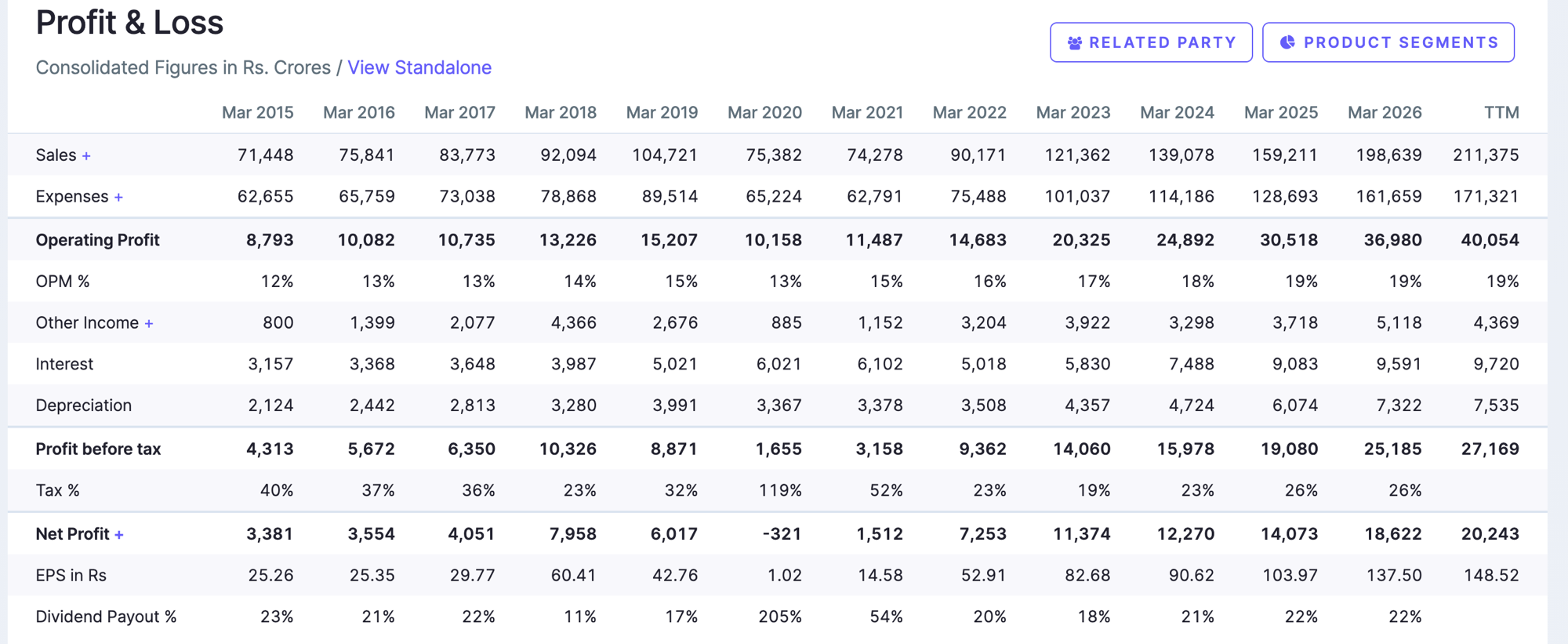
The numbers make it stark. In FY20 the losses from Mahindra's international subsidiaries alone came to more than ₹5,200 crore4, enough to wipe out most of the profit the good Indian businesses were working so hard to earn. The market had watched this pattern for years, and it drew the obvious conclusion: this was a management that could not be trusted to invest its cash wisely. And a company that is seen to destroy capital does not just earn less profit, it earns a steadily lower valuation multiple on that profit. That double blow, falling profits and a falling multiple, is why Mahindra dropped far more than the auto slowdown alone can explain.
The capitulation
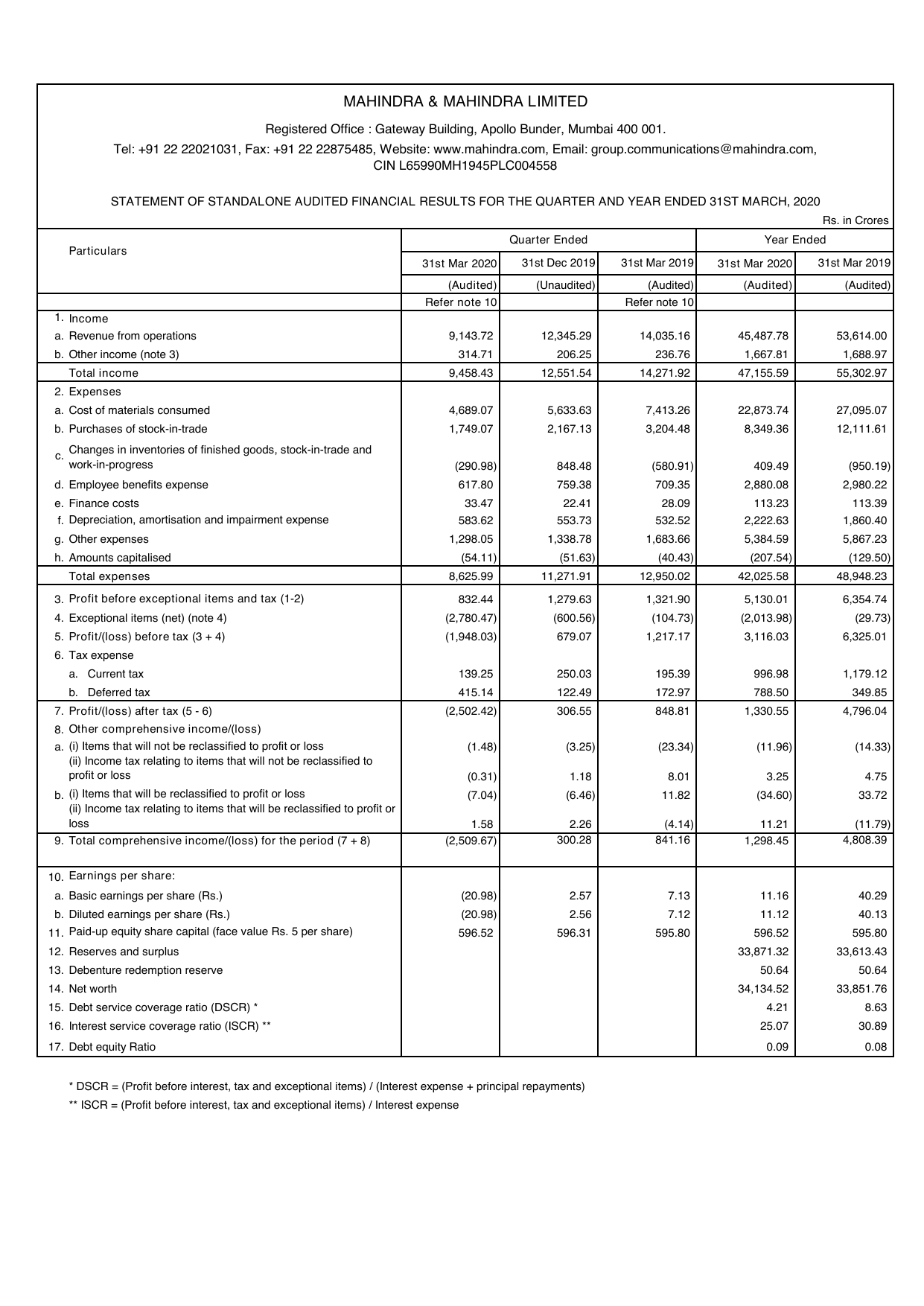
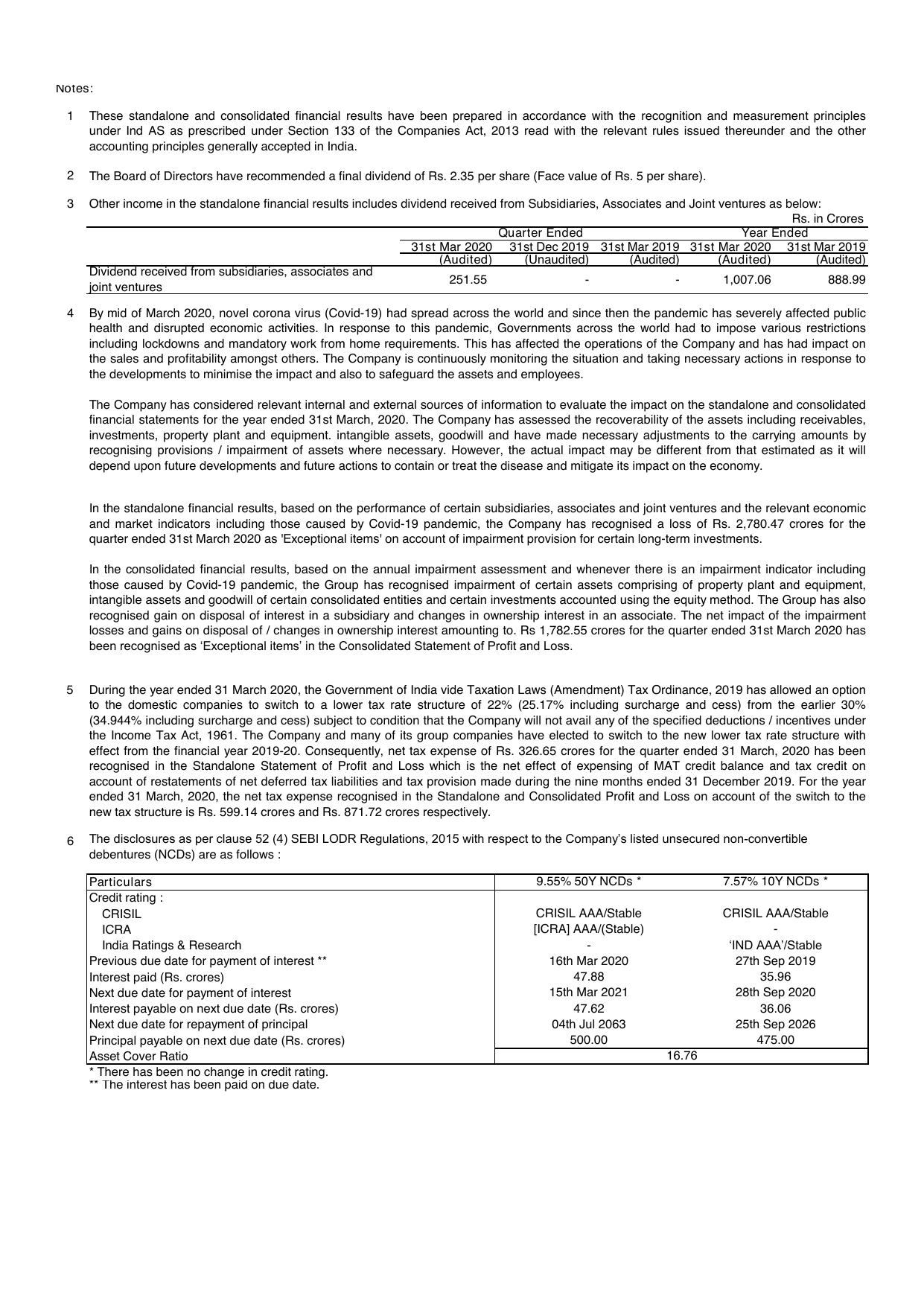
It all came to a head in the March 2020 quarter. Mahindra reported a standalone net loss of ₹2,502 crore1 for those three months, its first quarterly loss in nearly nineteen years. And the audited accounts named the culprit in black and white. Buried in Note 4 of the results was a ₹2,780 crore "exceptional item"2, an impairment provision on the company's long-term investments in its subsidiaries. That is the accountant's polite way of admitting that the foreign bets, SsangYong chief among them, were worth far less than Mahindra had paid for them. The very same filing pointed to COVID-19 as the trigger for the write-down. The evidence section below shows these pages directly.
The market had already been voting with its feet. The stock, which had been sliding for two years, fell to around ₹248 by late March 2020, a nine-year low, having dropped by roughly half in that single brutal month. For a company that had been in the ₹1 lakh crore club at its peak, this was total capitulation.
Investors who had held on through the whole two-year descent finally gave up. And, as so often happens in markets, that moment of maximum despair turned out to be almost exactly the turning point.
The turn: one hard rule
What changed was not the industry, which was still on its knees. What changed was discipline. Faced with the SsangYong disaster, the board refused to put in another rupee, and a new leadership under Anish Shah, then group CFO and soon to be CEO, imposed a single, brutally simple rule on the entire sprawling group: every business had to earn an 18% return on equity, or have a clear, quantifiable strategic reason to exist. Anything that could not clear that bar would be fixed, sold or shut.
Businesses were sorted into buckets: the ones clearing the hurdle would run as normal, the fixable ones would be turned around on a deadline, and the hopeless ones, the Category C cases, would be exited. And then, remarkably for a company famous for hanging on to its pet projects, management actually did it. Mahindra went on to exit around fifteen underperforming businesses. GenZe was shut. Peugeot Motocycles was sold. SsangYong was let go and eventually picked up by Korea's KG Group in 2023. The cash and the attention were redirected to the three things Mahindra was genuinely great at: SUVs, tractors and electric vehicles.
What happened next
The results were dramatic, and they came from focus rather than from any change in the market. Freed from the drain of the loss-makers, Mahindra threw itself back into its core, and the products finally landed. The reborn Thar became a cultural phenomenon. The XUV700, the Scorpio-N and then a credible electric range followed, and each one had waiting lists. Mahindra clawed back its SUV crown, and by FY26 it led the market it had been losing just a few years earlier.
The financials followed the focus. The promised 18% return on equity was hit within about a year and a half, far faster than anyone expected. And the stock, left for dead near ₹248 in March 2020, went on to compound at roughly 35% a year and multiply many times over from those lows. The whole spectacular recovery grew out of one unglamorous decision: to stop wasting money and spend it only where it earned a proper return.
What you could have seen, and when
The ₹2,780 crore write-off in the March 2020 quarter looked like a bolt from the sky, and the company pointed to COVID. It was not a bolt. A write-off is accounting catching up with cash that left years earlier, and where that cash was going had been disclosed, in the same annual reports, all along.
- Annual reports through FY18 and FY19Years ahead of the Q4 FY20 impairmentThe consolidated profit and loss account, read against the standalone one, plus the subsidiary schedule at the back of the annual reportLook upThe gap between what Mahindra earned on its own and what the group earned once every subsidiary was included. Then the schedule that lists each subsidiary with its revenue and its profit or loss, SsangYong among them.It told youThat gap is the price of the sprawl. The tractor and SUV business was earning well and quietly handing the money to arms that could not earn a return on it. You did not need to predict an impairment. You only needed to notice that the money was already gone, year after year, and that a write-off is simply the day the balance sheet admits it.
- Monthly, through FY19 and FY20Roughly a year and a half of monthly evidence before the March 2020 lowThe monthly sales numbers Mahindra and its rivals publish, and industry body dataLook upMahindra's share of the SUV market falling from 23.8% to 18.7% while Kia, MG and Hyundai launched into the same segment.It told youMarket share is published every month by the companies themselves. A five point fall in the segment a company was famous for owning is not a subtle signal, and it arrives twelve times a year rather than four.
- September 2018About 18 months before the troughThe IL&FS default, a dated public credit eventLook upNot a Mahindra document at all. IL&FS defaulting froze lending across vehicle finance, and most vehicles in India are bought with a loan.It told youWhen the finance stops, demand stops, whoever makes the vehicle. This is the kind of tell that lives outside the company you are studying, and it told you the whole industry was about to have a bad two years before a single quarterly result showed it.
Two things were genuinely not visible in advance. The exact size of the impairment depended on judgements management made in one quarter, and the auditors signed the accounts as true and fair either way. And the pandemic that shut the showrooms was nobody's forecast. What was visible was the underlying condition: money being spent for years without earning a return. COVID chose the date. It did not choose the outcome.
Straight from Mahindra's audited FY2020 results
Every figure above is taken directly from Mahindra & Mahindra's audited financial results for the year ended 31 March 2020, filed with the stock exchanges and signed by the Executive Chairman and the auditors. The two page images below are the actual pages, and the market-share and share-price figures in the story are separately sourced in the list beneath them.
Questions people ask
- Why did Mahindra's stock fall about 68%?
- On the surface it looked like an auto-cycle fall, but the real cause was capital allocation, meaning where management chose to spend shareholders' money. The industry genuinely weakened from 2018 after the IL&FS collapse froze auto lending, BS6 raised prices and COVID shut showrooms, and Mahindra's SUV share slipped from 23.8% to 18.7% as rivals like the Kia Seltos and Hyundai Creta took the market. But what turned a downturn into a two-thirds collapse was cash draining into loss-making subsidiaries. In FY20 the international arms alone lost more than ₹5,200 crore, enough to wipe out most of the profit the good Indian businesses earned.
- Why did Mahindra buy SsangYong, and what went wrong?
- Mahindra bought the Korean carmaker SsangYong out of bankruptcy in 2011 for roughly ₹2,100 crore, and the logic sounded good: a ready-made global SUV platform and brand. It then unravelled for reasons SsangYong could do little about. Its home market shifted from the diesel engines it was built around toward petrol, and key export markets weakened. The business kept losing money, and Mahindra's real failing was that it kept funding those losses. SsangYong was only the headline; there was also GenZe electric scooters in the US, Peugeot Motocycles in France, and aerospace and dairy ventures, a sprawl of drains.
- Was Mahindra's collapse caused by the industry or its own decisions?
- Its own decisions. The industry downturn was real but survivable; what deepened it into a two-thirds fall was where the cash went. Mahindra was spending across a sprawl of loss-makers abroad while its core Indian business worked hard to earn. The numbers make it stark: in FY20 the international subsidiaries alone lost more than ₹5,200 crore, enough to erase most of the Indian profit. That is why this is a capital-allocation story, not an auto-cycle story. The fixable problem was never the market; it was the choice of where to invest the shareholders' money.
- What made Mahindra finally turn around?
- Discipline, not a better market, which was still on its knees. The capitulation came in the March 2020 quarter, a standalone net loss of ₹2,502 crore, its first quarterly loss in nearly 19 years, with the stock at a nine-year low near ₹248. Facing the SsangYong disaster, the board refused to put in another rupee, and new leadership under Anish Shah imposed one hard rule: every business had to clear a defined return on capital. Businesses were sorted into keep, fix on a deadline, or exit. That single rule, applied to a sprawl of loss-makers, was the turn.
- How did Mahindra recover after 2020?
- By focus, not by the market improving. Freed from the drain of the loss-makers, Mahindra exited about 15 businesses and threw its cash back into its core, where the products finally landed. The financials followed the focus: the promised 18% return on equity was hit within about a year and a half, far faster than expected, and the stock, left for dead near ₹248 in March 2020, went on to compound strongly. The recovery came from stopping bad spending and concentrating capital on what earned a real return, which is why today's Mahindra is described as a different company.
Sources
- M&M Audited Financial Results FY2020 (investor relations) ↗
- SsangYong Motor files for bankruptcy (BusinessToday) ↗
- How Anish Shah steered Mahindra: capital allocation to bold bets (BusinessToday) ↗
- Kia, Hyundai, Tata gain UV market share in FY21 (Autocar India) ↗
- M&M reports first quarterly loss in 19 years (Business Standard) ↗
How it unfolded8 moments
- Apr 2018Joins the ₹1 lakh crore club at an all-time high. Peak confidence.
- Late 2018IL&FS collapse freezes vehicle finance; auto demand slumps.
- FY19 → FY20SUV market share slides from 23.8% to 18.7% as Kia, MG and Hyundai attack.
- 2019SsangYong losses balloon; overseas subsidiaries bleed cash.
- Mar 2020Stock hits a nine-year low near ₹248, down ~51% in a month. COVID shuts showrooms.
- Q4 FY20First quarterly loss in ~19 years. Board refuses to fund SsangYong.
- 2020-21The 18% ROE rule imposed; ~15 businesses exited (GenZe, Peugeot, later SsangYong).
- FY21 onwardThar, XUV700, Scorpio-N and EVs land; SUV leadership regained; stock multiplies many times over.
The fall was not really an auto-cycle story, it was a capital-allocation story. Mahindra collapsed because it was spending its cash badly across a sprawl of loss-makers, and it recovered because it stopped and focused the money on what earned a real return. This is why capital allocation, how management chooses to spend the shareholders' money, is one of the most important things to judge in any company. It rarely shows up in a single quarter's numbers, but over years it is the difference between compounding and destruction. When you look at Mahindra today, watch that discipline above all else, because you have now seen, in detail, exactly what it cost when the discipline was missing.
But not always. A gap is not automatically a warning. A company deliberately building something new will lose money in subsidiaries for years and be entirely right to do so. The questions that separate the two are how long the losses have run, whether they are narrowing, and whether management has ever stated a return threshold and then actually honoured it. Mahindra's recovery began the day it set a hard 18% return rule and walked away from businesses that failed it, including one it had owned for a decade.
The small numbers in the text mark the claims this story leans on. Here is where each one comes from, and how solid it is.
- 1The ₹2,502.42 crore standalone net loss for Q4 FY20 is from Mahindra's audited results filed with the exchanges in June 2020. Exact to the paisa in the filing.
- 2The ₹2,780.47 crore impairment on investments in subsidiaries sits in Note 4 of the same filed results, disclosed as an exceptional item. This is the single most checkable claim in the study: the note is in the public results document.
- 3The ~₹2,100 crore paid for control of SsangYong in 2011 is from contemporaneous deal coverage. The deal was priced in Korean won and dollars, so rupee figures vary a little by source and exchange rate.
- 4The ₹5,200+ crore of FY20 losses across the overseas subsidiaries is an aggregate drawn from the consolidated results and segment disclosures. It depends on which entities you count as 'international', so treat it as a fair estimate of scale rather than a single filed line.