Crompton Greaves: the one good deal that undid the company
Crompton's 2005 purchase of the distressed Belgian transformer maker Pauwels for about €32 million was a genuine masterstroke: it fixed the business and roughly doubled Crompton overnight. The damage came from believing one success was a repeatable formula. Crompton bought around nine overseas companies between 2005 and 2012, funded increasingly by debt that peaked near ₹7,500 crore, but the later targets lacked what made Pauwels work. As the power cycle turned and integration overwhelmed it, the whole overseas empire was sold or liquidated.
In 2005 Crompton Greaves bought a distressed Belgian transformer maker, Pauwels, for a low price, fixed it, and doubled in size almost overnight. It was a genuinely good deal. The problem is what Crompton concluded from it: that it had found a repeatable way to make money by buying troubled Western companies and running them on Indian costs.
Over the next decade it bought eight more businesses abroad, increasingly with borrowed money. The later deals did not have Pauwels' economics, the losses mounted, and the whole overseas empire was eventually sold or shut down. This is a study of one question: what happens when a company mistakes a single exceptional acquisition for a formula?
This is the first part of the story, and it ends in collapse. What happened next, after an accounting fraud in 2019 and a share price under ₹5, is told in a separate sequel: CG Power: what survived the collapse.
The deal that looked like genius
In May 2005, Crompton Greaves, then the flagship of the Thapar family's Avantha group, bought the transformer business of Pauwels, a family-owned Belgian company, for roughly €32 million, about ₹200 crore in the money of the day1.
For that price it got a lot. Pauwels was one of the top five makers of large three-phase transformers in the world, with factories in Belgium, Ireland, Canada, the United States and Indonesia, and customers among utilities across Europe and North America. It was not a small bolt-on. In FY06, its first full year inside Crompton, consolidated net sales were ₹4,127 crore against ₹2,521 crore for the standalone Indian business, so the acquired operations added roughly ₹1,600 crore of revenue and lifted profit after tax from ₹163 crore to ₹233 crore. Consolidated sales were about double the prior year's, and the deal put Crompton among the world's ten largest transformer makers2.
So a mid-sized Indian company spent about ₹200 crore and doubled in size, entering markets it could not otherwise have touched. On its face that is close to a perfect trade. The interesting part is why the price was so low, and what the low price should have told everyone.
What €32 million actually bought
Pauwels had no profit to measure the price against, which was the whole reason it was for sale, so measure it against sales instead. In its first full year inside Crompton the acquired business added roughly ₹1,600 crore of revenue, an equivalent of about €280 million. Against that, a €32 million price is about 0.11 times sales, for a top-five global maker of large power transformers with five plants on three continents.
That €32 million bought five qualified plants, the utility approvals, the customer relationships, and, within a year, a business earning about 20% on capital. Crompton was not really buying steel and buildings. It was buying customers, approvals and market access it could not have built quickly on its own.
First, why you cannot just start a transformer business
A power transformer is the large grey box in a substation that steps electricity up to a high voltage for long-distance travel and back down near your home. A grid cannot run without them, and when one fails an area goes dark. So utilities do not buy from whoever is cheapest. They buy from suppliers they have tested and trusted for years, after independent high-voltage tests, a track record of units running for a decade without failing, and often a factory and service team on their own continent.
That trust is the real barrier. To reach Western utilities on its own, Crompton would have had to build or buy Western factories, certify its transformers, install reference units and wait a decade to prove them, staff two continents, and lose bid after bid until a first utility gambled on an unknown Indian name. In 2005 Crompton had almost no presence in Europe or the Americas; Pauwels already had all of it. You are not paying for buildings in a deal like this. You are paying to skip the decade.
Pauwels was genuinely distressed: it had lost about €20 million in 2003, and the founding family, after decades in control, was selling because it could no longer make the business pay3.
So why was Pauwels losing money?
This is the part to be careful with, because the public record gives more than one figure for Pauwels' trouble and does not fully reconcile them. Transformer Magazine and US local press covering the 2005 sale report that Pauwels lost about €20 million in 20033. Other contemporary reporting puts the loss nearer €1.6 million on roughly €260 million of revenue in 2004, alongside significant debt and a manufacturing footprint the company had already begun to shrink19. Those are not the same number or the same year, and no public filing sets out a line-by-line cause, so treat what follows as a reading of the business rather than a documented account. The one thing every source agrees on is the direction: the promoters had put the company up for sale because it was losing money.
Start with what the losses were not. This was not a business whose product nobody wanted. Pauwels was an established maker of large transformers with plants in Belgium, Ireland, the United States, Canada and Indonesia and sales offices around the world, and its presence in Western Europe and North America was one of the main things Crompton was buying1. A company whose customers have walked away is worth very little. A company whose customers still want it but whose costs no longer add up is worth a great deal to the right owner.
So what had gone wrong sits on the cost and competition side, and there are two visible clues. The first is weak demand and competitive pressure: Pauwels' revenue had fallen, it had struggled to keep pace with larger global rivals, and it had already been trimming its own manufacturing, including cutting back its Belgian operations19.
The second clue is capacity utilisation, and it is worth slowing down on, because it is the heart of the fix. Picture a factory built to make 100 transformers a year that is only making 60. The building, the machines and most of the workers cost the same whether or not the other 40 get built, so all of that fixed cost now has to be loaded onto 60 units instead of 100. Each transformer that does get built carries a heavier share of the overhead and costs more than it should. That is what low utilisation means: plenty of capacity, not enough work going through it, and every unit dearer for it.
This was not a theoretical problem. After Crompton took over, Pauwels' capacity utilisation reportedly rose from around 60% to nearly 95%, as Crompton put in working capital, changed how the business was run, and pushed more volume through the same plants. Higher utilisation and scale pulled the per-unit cost down20.
There was also a cost edge waiting to be used. The plan was not to move the whole business to India but to combine the two. Pauwels already had the factories, the customers, the brand and the local presence in Western markets; Crompton could feed its cheaper Indian engineering, sourcing and manufacturing into that network. Later reporting described the gains in the same terms: better utilisation, global sourcing, scale and operating changes improving the economics of the acquired business20.
Put the pieces together and the opportunity comes into focus. Pauwels had a real business whose economics had decayed. The customers were still there, the products were still there, the international network was still there; but the cost base was too heavy, the plants were run too slack, and it could not hold its own against bigger global players. That is a very different thing from a company whose product or market has vanished.
This is where Crompton's bet gets interesting. It did not need to reinvent the transformer. It needed to make an existing business cheaper and better used: lower-cost Indian engineering and sourcing, higher utilisation of Pauwels' overseas plants, and the customer relationships and approvals that had taken decades to build left intact.
The early results backed the thesis. In its first period under Crompton, Pauwels contributed roughly ₹1,600 crore of revenue2 and about ₹39 crore of profit21. By FY07 the combined Pauwels and Ganz operations reportedly turned over about €403 million with roughly €23.8 million of operating EBITDA, a margin near 5.9%21.
That is what made Pauwels such a good buy. Crompton was not purchasing a business with no future; it was purchasing a valuable industrial franchise whose economics had turned unattractive, and it believed it knew how to turn them back. And that is the distinction that matters later. The lesson Pauwels actually taught was not that Crompton knew how to buy troubled companies. It was that Crompton knew how to fix this particular kind of troubled company: one with living customers, real approvals, a heavy Western cost base and slack plants, bought cheap into the bottom of a cycle. Those are very different lessons, and the gap between them is the rest of this story.
Why this was a sensible bet in 2005
Without knowing the ending, several things made the price defensible. It was low against what the platform would cost to build, and buying below the cost of building is the oldest good reason to acquire anything. The losses looked fixable rather than fatal: utilities still wanted Pauwels' transformers, the problem was a high-cost Western base making units it could not price high enough to cover, and an Indian owner could plausibly fix that by shifting the price-sensitive work to cheaper engineering in India while keeping the Western plants for the high-end units and the local presence customers demanded.
And the deal unlocked something money alone could not buy: overnight, Crompton could sell into European and American utilities under a name they already trusted. Cheap, fixable, and a shortcut past a real barrier. None of this needs hindsight; it was a good bet.
Why it worked, at first
The bet paid off quickly. Crompton kept the Western factories and their approvals, leaned on cheaper Indian engineering where the work allowed, and pushed more volume through plants that had been running half-empty. The acquired business swung from losses to about 20% return on capital by FY06, a genuine turnaround, not a paper one16, and consolidated numbers jumped because a company Crompton's own size had been bolted on2. The timing helped too: the years after 2005 were a global boom in power investment, and transformer demand was strong.
So Crompton looked like a company that had cracked something hard: taking a tired Western asset and making it earn with Indian costs and a rising market. The stock was rewarded and the management praised. The trouble is what that success taught. A mediocre deal teaches caution; a brilliant one convinces you it was skill you can repeat. Pauwels had a bargain price, a fixable problem, an Indian cost edge, unbuyable market access and a rising cycle, all at once. Crompton treated that rare alignment as a formula.
The playbook becomes a spree
What followed was not one more deal but a decade of them. From 2005, Crompton acquired around nine businesses abroad: Ganz in Hungary in 2006, Microsol in Ireland in 2008, Sonomatra in France, MSE Power Systems in the United States, QEI in the United States, Emotron in Sweden, and, the largest and last of the run, the Spanish smart-grid company ZIV in 20124.
The rationale each time echoed Pauwels: a Western company with capabilities or customers, at a reasonable price, which Crompton would improve with Indian engineering costs. The appetite was explicit. Crompton's then managing director, S M Trehan, liked to say it was better to be a small fish in an ocean than a big frog in a well13.
The money to buy them increasingly came from borrowing. Crompton's own consolidated borrowings roughly doubled in the single year to March 2012, from about ₹395 crore to ₹985 crore, with the term loans secured against assets in Ireland and the United States, the overseas plants themselves17. At the wider Avantha group level the borrowing reached around ₹7,500 crore by March 20145.
The copies that only looked alike
The later deals looked similar on the surface. Underneath, the economics were different, because the conditions that made Pauwels work were mostly missing.
ZIV, the Spanish smart-grid company bought in 2012, is the clearest inversion: not distressed but growing and profitable, bought near a full price (its private-equity seller booked a 29% annual return on exit), in electronics where Indian labour cost saves little, funded with debt, and well after the boom had turned15. The more telling case, though, is not the opposite of Pauwels but the one that looked most like it and still failed: Ganz.
Ganz: distressed, but not another Pauwels
A year after Pauwels, in 2006, Crompton bought Ganz, a 130-year-old Hungarian maker of transformers, switchgear and rotating machines, for an enterprise value of about €35 million. It even bought it through the Pauwels subsidiary itself, so consciously was this Pauwels being run again14.
On the label Ganz was the perfect sequel: another storied European transformer maker, another distressed seller, a similar price. But distress was the only thing the two deals shared. Pauwels was cheap against its sales and came clean; Ganz came at a similar price but with the wider Transelektro group's loan liabilities attached, so Crompton took on more than the sticker14. Pauwels had a fixable problem and was earning a healthy return within a year; Ganz's problems ran deeper, were never fixed, and the Hungarian operation limped on for over a decade before being liquidated in 202014. Same starting label, almost none of the same economics.
Why the formula stopped working
Two things worked against the later deals. First, the cycle turned. The 2007-2010 power boom pulled a wave of new capacity into the transformer industry, and then demand rolled over: after 2008 Western utility spending stayed weak, the euro-zone crisis hit Europe through 2012, and Indian grid and power projects slowed. Supply had grown into a market that stopped growing. In India, transformer capacity more than doubled in about five years while the end-market grew under 4% a year, and the resulting over-capacity turned into heavy price competition that hit every maker's profitability18. Crompton's own FY2011-12 report said as much, calling the outlook for the year ahead depressed, with Greece, Spain and a slow US recovery all named.
Second, integration got harder. Fixing one distressed company is a project; running scattered plants across Belgium, Hungary, Ireland, Canada, the US, Indonesia, Sweden and Spain, each with its own costs, unions, regulators and currency, is a far harder job. The Indian-cost saving also had a limit, because you cannot move a utility's approved factory to India without losing the approvals you paid for.
So the losses spread. By around FY13 Crompton posted its first annual loss in roughly a decade, the overseas operations the main reason, even as the Indian business kept making money6.
The numbers turn
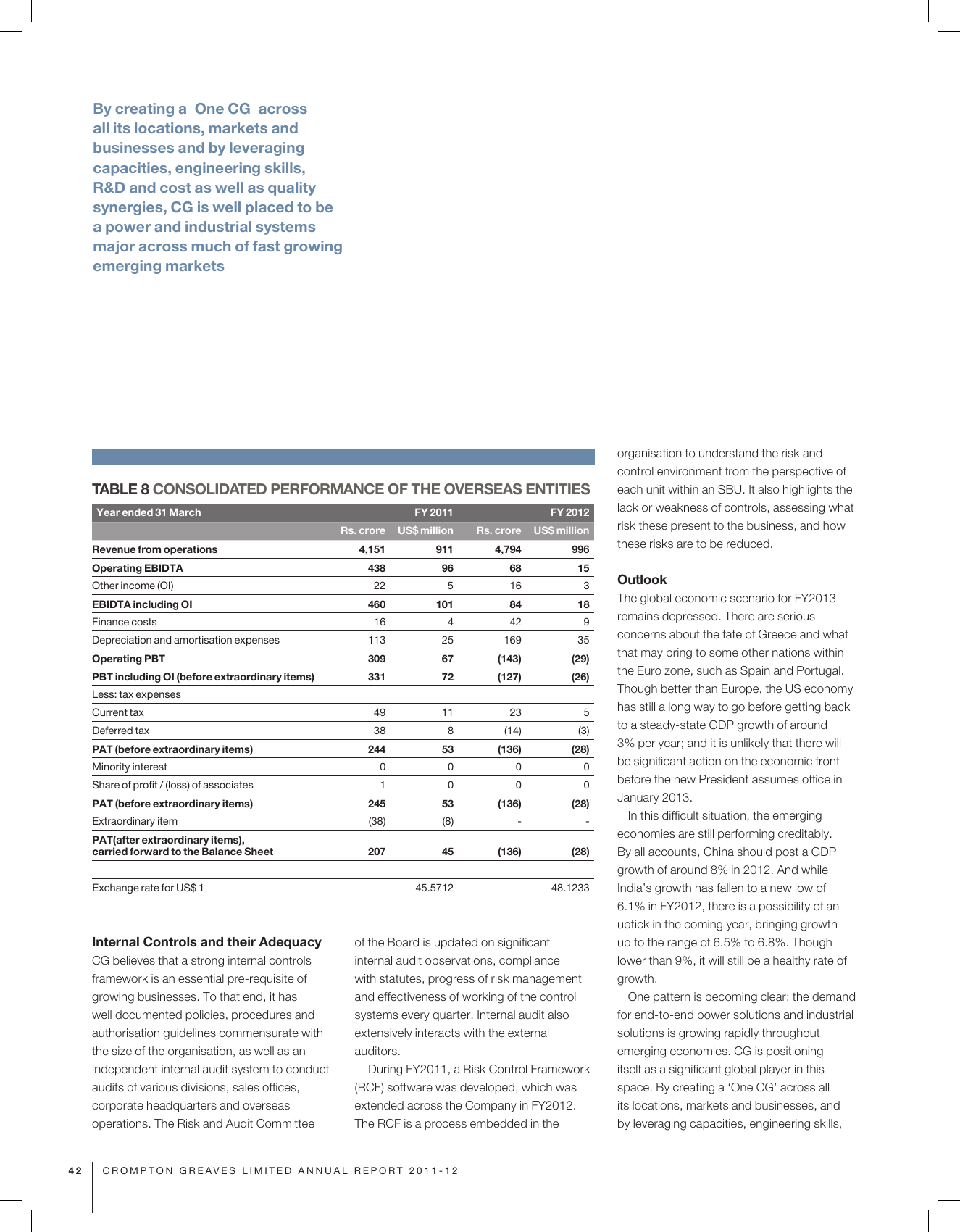
The turn is written into Crompton's own consolidated annual report for FY2011-1217. In one year, overseas sales rose while the Power Systems segment's profit fell about 70% (₹807 crore to ₹239 crore), finance costs doubled, and the company's own borrowings roughly doubled to about ₹985 crore. Rising sales, rising assets, rising debt, falling profit: Crompton was getting bigger without getting better.
The mechanism was a simple loop. More acquisitions meant more debt, more debt meant more interest, and the interest had to be paid whether the foreign plants earned it or not. When they failed to earn enough, the debt remained, and eventually the group had little choice but to sell the businesses it had spent years assembling. It steepened fast. By around FY13 the group posted its first annual loss in about a decade6; by FY15 the international arm still turned over roughly ₹4,800 crore, all loss-making7; and for the quarter ending December 2015 Crompton reported a consolidated net loss of about ₹107 crore against a healthy profit a year earlier, and the stock fell sharply8. By 2014-2015 the group's survival was in question9. (The ₹7,500 crore of debt often quoted for March 2014 is the wider Avantha group, not this listed company alone5.)
The unwind
The rescue was the whole strategy run in reverse: sell what the spree had bought, and split the company so the healthy half could be saved. In 2015 the group carved out the consumer business, the fans, pumps and lighting most Indians associate with the Crompton name, and sold control to Advent International and Temasek for about ₹2,000 crore. That business was later listed as Crompton Greaves Consumer Electricals and went on to do well; it is a different company from the one this study is about10.
From 2016 to 2020, Crompton dismantled the overseas empire piece by piece, selling the viable businesses (the foreign transmission-and-distribution arm to First Reserve, the Spanish smart-grid unit ZIV to Alfanar) and liquidating the rest11. The disposal values landed in the same broad order of magnitude as the original purchase prices, after years of losses in between. Crompton had spent a decade and a rising mountain of debt to buy, run and then exit an empire, and had roughly the same modest sums to show for the pieces at the end. The remaining Indian power business became CG Power and Industrial Solutions12.
So, was Pauwels a good deal?
Pauwels was a good deal, and it is worth being clear about why. A bargain price, a fixable problem, an Indian cost edge, unbuyable market access and a rising cycle were all present at once. That rare alignment was the advantage Crompton mistook for a repeatable skill.
Be precise about the claim, because fact shades into interpretation here. The fact is that the acquisition spree, the debt that funded it, and the overseas losses that followed were a large and direct part of Crompton's collapse. The interpretation, strongly supported but not documented, is why the spree happened at all: a belief, drawn from Pauwels, that Crompton could turn distressed Western assets into profit almost anywhere. The deal was good. The lesson Crompton took from it was not.
What you could have seen, and when
This is a harder case than most for spotting trouble early, because for years the numbers looked good and the strategy looked vindicated. But the shape of the risk was visible to anyone reading the annual reports, if they watched the right lines rather than the headline growth.
- Annual reports, 2006 onwardsYears before the losses, while the story still looked like a triumphThe acquisitions and goodwill notes, and the segment note splitting India from overseasLook upThe steady stream of new foreign acquisitions year after year, and how much of the group's revenue and, crucially, its profit came from overseas versus from India.It told youA company buying something abroad almost every year is increasingly dependent on finding another good deal and integrating it successfully. That is not automatically bad; a disciplined serial acquirer paying with cash can compound beautifully. It is a warning specifically when the buying is debt-funded and the acquired segment's returns are already slipping, because then it is a bet on a pipeline of bargains that tends to run dry.
- The FY2011-12 consolidated annual reportVisible in the FY12 report, about a year before the first annual lossThe segment note (geography and business) and the borrowings note, read together on facing pagesLook upThe composite pattern, all in one report: overseas sales up (₹4,952 to ₹5,534 crore) and overseas assets up (₹1,016 to ₹1,534 crore, against just ₹723 crore at home), while Power Systems profit fell about 70% (₹807 to ₹239 crore), finance costs more than doubled (₹20 to ₹46 crore), and the company's own borrowings roughly doubled (₹395 to ₹985 crore).It told youThis is the actual warning signature, and it is quantitative and primary. Any one line is explainable; all of them moving together says the strategy is buying revenue and assets that no longer earn, on borrowed money. A business that is a growing share of your sales and assets but a shrinking share of your profit is scale being mistaken for success. The same divergence, debt rising while the overseas segment's returns thinned, was visible across several years of reports, with the Indian business quietly carrying the group. You could read it a full year before the first annual loss.
What careful filing-reading would not have caught was the separate accounting-fraud scandal that hit the remaining power company (CG Power) in 2019, well after the overseas story had played out. Reading annual reports protects you from a visible strategy going wrong. It does not protect you from figures that were misstated in the first place.
One good deal, and the decade it set off
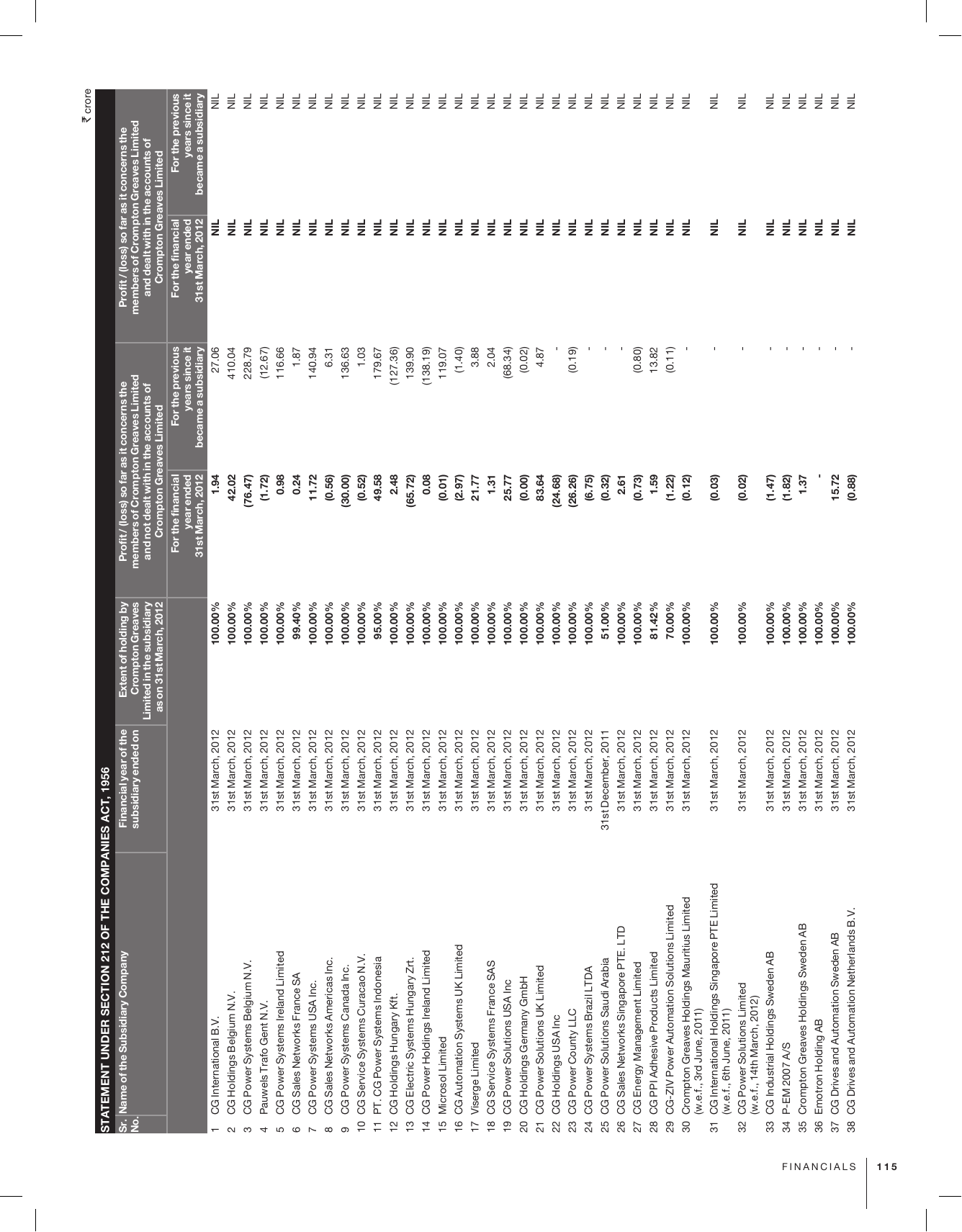
The rows marked [tier A] are lifted directly from Crompton Greaves' own FY2011-12 consolidated annual report and are the hardest evidence in this study; the FY11 to FY12 turn (rising sales and overseas assets against collapsing Power Systems profit, doubling finance costs and doubling borrowings) is visible in a single filing. Purchase and sale prices elsewhere are enterprise values or headline deal values from contemporaneous reporting and can differ from the cash that actually changed hands after debt and liabilities. The direction is not in doubt: an empire assembled over a decade was dismantled for sums of the same modest order as the pieces had cost.
Questions people ask
- Why did Crompton Greaves buy Pauwels in 2005?
- Crompton bought Pauwels because it was a cheap shortcut past a barrier it could not otherwise cross. For about €32 million, roughly ₹200 crore, it acquired one of the world's top-five makers of large transformers, with certified plants across Belgium, Ireland, Canada, the US and Indonesia and trusted relationships with Western utilities. Building that access alone would have taken a decade of certifications and reference installations. Pauwels was distressed only because its factories ran near 60% utilisation, a fixable problem, and after the deal Crompton lifted utilisation toward 95% with working capital and Indian engineering costs.
- Why was the Pauwels deal such a good one?
- Pauwels worked because five advantages lined up at once, a rare alignment. The price was low against what building the platform would cost; the losses were operational rather than a dead product, so they were fixable; Indian engineering and sourcing gave a cost edge; the deal bought unbuyable access to Western utilities under a trusted name; and the power cycle was rising. Within a year the acquired business added about ₹1,600 crore of revenue and earned around 20% on capital. That was a genuine masterstroke. The trouble was what Crompton concluded from it.
- How did one good deal undo Crompton Greaves?
- Success convinced Crompton it had a repeatable formula, so it turned a single deal into a spree. From 2005 to 2012 it bought around nine overseas companies, funded increasingly with borrowing that roughly doubled in the year to March 2012 alone and peaked near ₹7,500 crore by 2014. But the later targets were not Pauwels; some, like Spain's ZIV, were bought near full price rather than distressed. When the power cycle turned down after 2008 and integrating scattered plants across eight countries overwhelmed management, the foreign operations bled while the interest on the debt fell due regardless.
- When did Crompton Greaves' acquisitions start to fail?
- The numbers turned around FY2011-12, written into Crompton's own consolidated accounts. In a single year the Power Systems segment's profit fell about 70%, from ₹807 crore to ₹239 crore, while finance costs doubled. By roughly FY13 Crompton posted its first annual loss in about a decade, with the overseas operations the main cause even as the Indian business kept earning. The mechanism was a simple loop: more acquisitions meant more debt, more debt meant more interest, and that interest was due whether the foreign plants earned it or not.
- What happened to Crompton Greaves' overseas businesses?
- The rescue was the strategy run in reverse. From 2015 the group split off the consumer business of fans, pumps and lighting so the healthy half could be saved, then from 2016 to 2020 dismantled the overseas empire piece by piece, selling the viable units such as the foreign transmission-and-distribution arm and Spain's ZIV, and liquidating the rest. The overseas revenue that had reached about ₹4,800 crore in FY15 was wound down. What began as a doubling in 2005 ended as a decade-long unwind.
- Was buying Pauwels a mistake?
- No, and that is the surprising part. Pauwels itself was a good deal, arguably a great one: a bargain price, a fixable problem, an Indian cost edge, unbuyable market access and a rising cycle, all present at once. The mistake was treating that rare alignment as a formula and repeating it nine times on borrowed money. The precise lesson is that one success does not prove repeatability, and turning a masterstroke into a debt-funded spree is how a good deal becomes the reason for a disastrous one.
Sources
- Will the Pauwels phoenix rise from the ashes of CG transformers? (Transformer Magazine) ↗
- CG buys transformer biz of Pauwels (Business Standard, 2005) ↗
- Pauwels Transformers sold to Indian company (Missourian) ↗
- Avantha pays the price for gamble on growth (Business Standard) ↗
- Crompton Greaves to sell foreign T&D business (Business Standard) ↗
- Crompton Greaves reported Rs 107.03 cr loss in Q3 (Business Standard / PTI) ↗
- How the 146-year-old Crompton has managed to stay afloat (Forbes India) ↗
- Crompton Greaves Limited 75th Annual Report (FY2011-12), consolidated financials and segment notes (BSE) ↗
- Crompton Greaves Limited 75th Annual Report (FY2011-12), full PDF (the source of the Table 8 and Section 212 exhibits above) ↗
- CG International BV acquires Ganz Transelektro (Windtech International, 2006) ↗
- CG Hungary (Ganz) liquidation proceedings initiated (Transformers Magazine) ↗
- Arab firm Alfanar acquires Spanish smart-grid provider ZIV; Dinamia/N+1 exit at a 29% IRR (Baker Tilly Tech M&A) ↗
- Indian transformer industry: over-capacity and pricing pressure (Electrical India) ↗
- CG Power and Industrial Solutions (Wikipedia, for the post-2016 corporate timeline) ↗
How it unfolded10 moments
- 1958Emmanuel Pauwels founds the transformer company in Mechelen, Belgium; it grows into a top-five global three-phase transformer maker over the following decades.
- 2003Pauwels posts a loss of about €20m; the founding family, after decades in control, looks to sell.
- May 2005Crompton Greaves buys the Pauwels transformer business for about €32m, doubling its size and becoming a top-ten global transformer maker.
- 2006-2012Crompton buys around eight more businesses abroad, including Ganz (Hungary), Microsol (Ireland), MSE and QEI (US), Emotron (Sweden) and ZIV (Spain), largely with borrowed money.
- FY13Crompton reports its first annual loss in about a decade, with the overseas operations the main drag while the Indian business stays profitable.
- Mar 2014Group debt reaches around ₹7,500 crore as the debt-funded acquisitions weigh on the balance sheet.
- 2015The consumer business is carved out and a controlling stake sold to Advent and Temasek for about ₹2,000 crore; later listed as Crompton Greaves Consumer Electricals.
- 2016Crompton agrees to sell its foreign T&D business to First Reserve (EV ~€115m) and ZIV to Alfanar (EV ~€120m), dismantling the overseas empire.
- 2017-2020US operations sold to WEG, Canada to PTI Holdings; Belgian, Irish and Indonesian units liquidated by around 2020.
- 2019-2020The remaining Indian power company (CG Power) is hit by an accounting-fraud scandal; the Thapar group loses control and Tube Investments (Murugappa group) takes it over.
But not always. Serial acquisition is not always a trap. Some companies genuinely industrialise it, with a disciplined price ceiling, cash rather than debt funding, and a real integration engine that has worked across many deals, not one. The danger sign is specifically the single-triumph justification and debt-funded expansion into assets that do not share the reasons the first one worked.
A brilliant first deal is dangerous because it can make a rare set of circumstances look like a repeatable skill.
The small numbers in the text mark the claims this story leans on. Here is where each one comes from, and how solid it is.
- 1Source tier C (reputable contemporary reporting). The ~€32m / ~$34.7m Pauwels purchase price and May 2005 date are consistently reported across Transformer Magazine, Business Standard and US local coverage of the Washington, Missouri plant. The ₹200 crore rupee figure is an approximate conversion at then-prevailing rates and is indicative, not exact. Would upgrade to A/B against Crompton's FY05-FY06 annual report.
- 2Source tier A (audited annual report). The FY06 figures come from Crompton Greaves' own Ten Years' Financial Highlights in the FY2011-12 annual report: consolidated net sales ₹4,127 cr versus standalone ₹2,521 cr, a difference of about ₹1,600 cr from the acquired overseas operations, and consolidated profit after tax ₹233 cr versus standalone ₹163 cr. Consolidated net sales were roughly double the prior year's standalone ₹1,973 cr. The ~€280m revenue behind the 0.11x price-to-sales ratio is this ₹1,600 cr converted at the era's rate, so 0.11x is an order-of-magnitude figure. The 'top five / among the ten largest' ranking is contemporaneous coverage (tier C); an earlier 'seventh-largest' phrasing was softened accordingly.
- 3Source tier C. Pauwels' ~€20m loss in 2003 and the family sale after decades of ownership are reported by Transformer Magazine and US local press covering the acquisition. That Pauwels itself was genuinely distressed is well established across sources.
- 4Source tier B/C (company disclosures plus reporting). The count of roughly nine overseas acquisitions and the named targets (Ganz, Microsol, Sonomatra, MSE, QEI, Emotron, ZIV) are drawn from contemporaneous coverage and company disclosures. Different sources count slightly differently depending on whether small units and joint ventures are included, so 'around nine' is the safe figure.
- 5The company's own borrowings are tier A. Crompton's Ten Years' Financial Highlights (FY2011-12 annual report) show consolidated borrowings falling from ₹904 cr (FY07) to ₹470 cr (FY11), then jumping to about ₹1,044 cr in FY12 (this includes current maturities; the itemised balance-sheet notes give ₹985 cr of long plus short-term borrowings). The ~₹7,500 crore figure for March 2014 is the wider Avantha group across several companies (Business Standard, tier C/D), not this listed company alone.
- 6Source tier C. That FY13 was Crompton's first annual loss in about a decade, driven by the overseas business, is supported by contemporaneous reporting. The precise full-year loss figure varies between sources and quarters, so the study deliberately describes the fact of the loss rather than a single rupee number.
- 7Source tier C. Overseas revenue of about ₹4,800 crore in FY15 comes from Business Standard's reporting around the sale of the foreign business. That the overseas operations were loss-making at that point is consistently reported. The overseas return-on-capital and profit-share pattern described in the ex-ante section is directional, inferred from the segment splitting into losses while carrying rising revenue; the exact segment ROCE series would need the annual reports to state precisely.
- 8Source tier C (contemporaneous). The Q3 FY16 (quarter ended December 2015) consolidated net loss of about ₹107 crore, against a profit of roughly ₹274 crore a year earlier, and the sharp fall in the stock, are from Business Standard / PTI reporting at the time.
- 9Source tier D, interpretation. The description of Crompton itself as near bankruptcy by 2014-2015 reflects Forbes India and Business Standard coverage of the group's distress and forced restructuring. It is an interpretation supported by the debt load and losses, not a formal insolvency filing at that date.
- 10Source tier C. The 2015 sale of a controlling stake in the consumer business to Advent International and Temasek for about ₹2,000 crore, and its later separate listing as Crompton Greaves Consumer Electricals, are well documented (Forbes India, Business Standard). This consumer company is distinct from the power company this study concerns.
- 11Source tier C. The overseas disposals (First Reserve EV ~€115m for the foreign T&D business; ZIV to Alfanar EV ~€120m; US to WEG ~€37m; Canada to PTI ~$20m; liquidation of Belgian, Irish and Indonesian units around 2020) are from Business Standard and Transformer Magazine. Enterprise values differ from net cash received; some announced deals were later restructured, but the overall dismantling is well established.
- 12Source tier C. The 2019 accounting-fraud episode at CG Power, the Thapar group losing control, and Tube Investments (Murugappa group) taking over in 2020 are widely reported and are summarised on the CG Power corporate record. These events are downstream of, and separate from, the acquisition strategy that is this study's subject.
- 13Source tier C/D. The 'small fish in an ocean' framing is attributed to Crompton's then managing director S M Trehan in retrospective coverage of the group's overseas strategy. It is used here as an illustration of stated appetite, not as a load-bearing number.
- 14Source tier B/C. The Ganz (Transelektro) acquisition in 2006 at an enterprise value of about €35m, the assumption of the wider Transelektro group's loan liabilities, and the 2020 liquidation of the Hungarian operation are from the contemporaneous CG International announcement (Windtech International) and later Transformers Magazine reporting. The characterisation of Ganz as never turned around is an interpretation consistent with its loss-making history and eventual liquidation.
- 15Source tier C. That ZIV was a growing, profitable smart-grid company rather than a distressed one, and that its private-equity seller (Dinamia / N+1) exited in 2012 at roughly a 29% annual return, are from Baker Tilly's account of the later Alfanar sale. This is the basis for treating ZIV as the inversion of Pauwels; the ✓/✗ marks in the replication matrix are interpretation built on these facts, with genuinely unestablished cells left as '?'.
- 16Two returns support the 'genuine turnaround' claim. At group level, Crompton's own Ten Years' Financial Highlights (FY2011-12 annual report) show Return on Tangible Net Worth of about 31% for FY06 (tier A). For the acquired Pauwels business specifically, Windtech International cites about 40% revenue growth and 20.4% ROCE for fiscal 2005-06 (tier B/C). The unit had lost about €20m in 2003 and was earning a healthy return within a year of the 2005 acquisition.
- 17Source tier A (audited annual report), the hardest evidence here. The FY2011-12 figures are taken directly from Crompton Greaves' 75th (FY2011-12) consolidated annual report: overseas sales ₹4,951.90 cr to ₹5,533.88 cr; overseas fixed assets ₹1,534.43 cr against ₹723.10 cr domestic; Power Systems segment result ₹806.84 cr to ₹239.38 cr; consolidated profit before tax ₹1,229.13 cr to ₹549.74 cr; finance costs ₹20.06 cr to ₹46.34 cr; consolidated borrowings (long plus short term) ₹395.49 cr to ₹984.85 cr, with term loans secured on assets in Ireland and the USA. Segment results are reported by business, not geography, so the profit collapse is shown for Power Systems, which houses the overseas transformer operations, read alongside the geographic split of sales and assets. Figures are rounded in the prose.
- 18The industry-cycle claim rests on two kinds of evidence. Tier C (industry/trade coverage): Indian transformer manufacturing capacity more than doubled in about five years while the end-market slowed to under 4% annual growth, producing over-capacity and heavy price competition that hurt every maker's profitability, with capacity-utilisation estimates clustering around 60-70% in that period (Electrical India; broadly corroborated by other sector coverage that puts utilisation falling from the mid-80s in 2008-09 toward the high-40s by 2014-15). Tier A (primary): Crompton's own FY2011-12 annual report calls the outlook for FY2013 'depressed', citing Greece, Spain, Portugal and a slow US recovery. Note the honest limit: the cycle is the backdrop that made the later deals hard, not the proximate cause of the single FY12 overseas loss, which management attributed mainly to raw-material costs and re-work at the Belgian and Canadian plants.
- 19Provisional, primary source pending. The figure of a ~€1.6m loss on roughly €260m of revenue in 2004, plus significant debt and a manufacturing footprint Pauwels had already begun to shrink (including cutbacks to Belgian operations), is drawn from a secondary draft citing contemporary reporting; the primary source has not yet been independently traced. It sits alongside, and is not reconciled with, the ~€20m 2003 loss in note 3, which comes from a different set of sources and a different year. Both are reported honestly here as differing figures for the same 'losses before sale'; the reason for the gap (different entity scope, different accounting year, or different measure) is not documented. Treat the €1.6m/2004 figure and the plant-cutback detail as provisional until a primary source is confirmed.
- 20Mixed confidence. The qualitative claim, that better capacity utilisation at the overseas units (Pauwels, Ganz, Microsol) drove the turnaround and that overseas operating margins expanded materially after the acquisition, is supported by contemporaneous Business Standard coverage (tier C) and consistent with note 16. The specific numbers, utilisation rising from about 60% to nearly 95% and the description of Crompton adding working capital, global sourcing and operating changes, are from a secondary draft and not yet traced to a primary source. Treat the exact 60%-to-95% figures as provisional.
- 21Provisional, primary source pending. The ~₹39 crore of profit attributed to Pauwels specifically in its first period under Crompton, and the FY07 combined Pauwels+Ganz figures of about €403m sales, ~€23.8m operating EBITDA and a ~5.9% margin, come from a secondary draft; the primary sources (Crompton's FY06 and FY07 annual reports) have not yet been confirmed. Note that the ~₹1,600 crore first-year revenue in the same sentence is separately and firmly sourced in note 2 (tier A); it is only the ₹39cr Pauwels-only profit and the euro FY07 figures that are provisional here.